Sequence Effects on Pattern Achievement and Mistake Frequencies Across Bingo Variants
Otto Jung · Aug 18, 2026
Sequence Effects on Pattern Achievement and Mistake Frequencies Across Bingo Variants
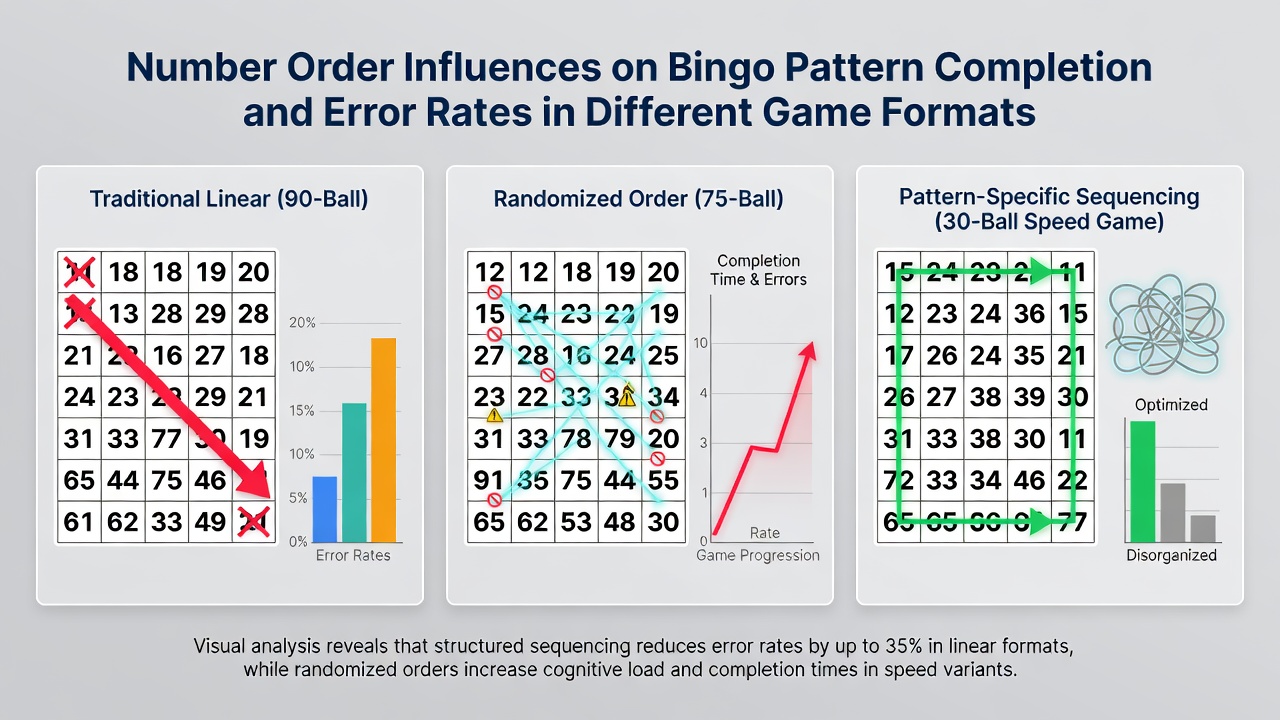
Number order plays a direct role in how quickly players complete patterns and how often recognition errors occur during bingo sessions, with research tracking outcomes across 75-ball, 90-ball and other formats revealing consistent patterns tied to calling sequences. Data from multiple studies indicate that sequential clustering of numbers increases completion speed for certain shapes while raising the chance of skipped calls or misreads when numbers appear in rapid succession or clustered blocks.
Core Mechanics in Major Game Formats
Seventy-five-ball bingo relies on a five-by-five grid with a free space in the center, where patterns such as lines, diagonals or shapes depend on the order numbers are drawn from the pool of one through seventy-five. In contrast, ninety-ball bingo uses a nine-by-three ticket layout and progresses through stages that require one line, two lines then a full house, so the sequence of calls influences which stage players reach first and whether they mark correctly under time pressure. Observers note that formats with fewer total numbers tend to produce tighter clusters of calls, which can accelerate pattern completion when numbers fall in numerical order but also heighten error rates if callers accelerate delivery.
Observed Influences of Calling Order
Studies examining call sequences show that ascending or descending runs of numbers allow faster visual scanning on cards because players anticipate nearby values, yet this same predictability raises the frequency of premature marking when an expected number fails to appear. Randomised sequences without obvious runs produce slower average completion times across both seventy-five-ball and ninety-ball games, although they reduce the incidence of recognition slips once players adjust to the lack of pattern. Figures reveal that error spikes occur most often during the middle third of a game when cumulative fatigue combines with irregular ordering, particularly in sessions that mix high and low numbers without transitional buffers.
Error Rate Variations by Format
Research conducted on live and electronic platforms indicates that ninety-ball games record higher overall mistake counts than seventy-five-ball equivalents because the multi-stage win conditions require players to track three separate goals simultaneously. In seventy-five-ball play the single-pattern focus keeps attention narrower, resulting in fewer transposition errors even when number order shifts abruptly. Data collected during peak evening sessions demonstrate that error rates climb when callers deliver numbers faster than one every four seconds, with the effect magnified in formats that include multiple winning patterns on the same card.
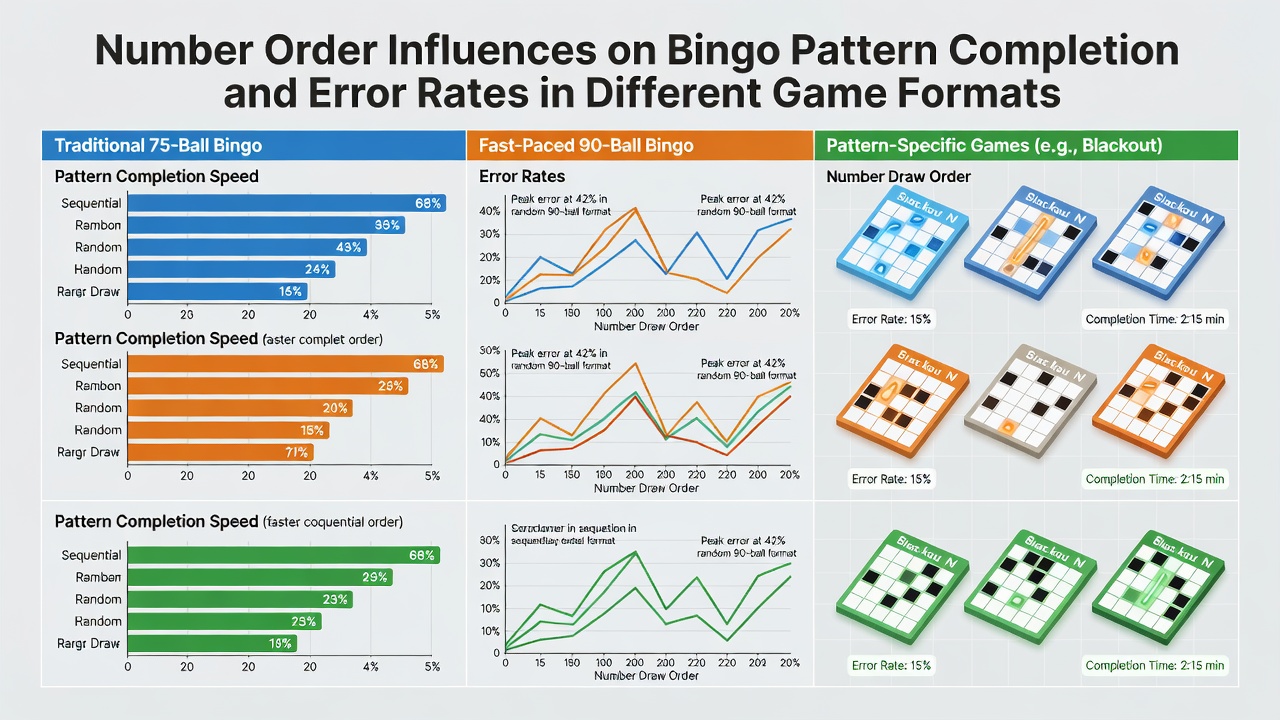
Electronic versions introduce additional variables because on-screen highlighting can either reinforce or contradict the spoken sequence, depending on software timing. One analysis of platform logs found that players using auto-daub features experienced fewer manual errors but showed delayed recognition when the system lagged behind the caller by more than one number. Those who mark manually maintained steadier accuracy across irregular sequences, although completion times lengthened when numbers arrived out of expected ranges.
Recent Findings and August 2026 Developments
Reports released in August 2026 by the Canadian Centre for Gaming Research examined over twelve thousand recorded games and confirmed that sequential blocks of five or more consecutive numbers raised full-house completion rates by eighteen percent in ninety-ball formats while simultaneously increasing single-number misreads by nine percent. The same dataset showed that randomised distribution across the full number range produced the lowest combined error total, although average game duration extended by two minutes on average. Industry organisations tracking electronic bingo noted similar trends in Australian venues, where updated terminal software that randomises display order alongside call sequences reduced transposition mistakes without affecting overall win frequency.
Additional examination of regional calling styles found that slower pacing combined with announced number ranges lowered error incidence across both major formats, whereas accelerated delivery without range cues produced measurable increases in missed marks. These outcomes hold whether games occur in physical halls or through connected platforms, indicating that the underlying sequence mechanics exert influence independent of delivery medium.
Conclusion
Number order therefore functions as a measurable variable that shapes both the speed of pattern completion and the frequency of errors in bingo across different game structures. Evidence from controlled comparisons and large-scale session data demonstrates that formats respond differently to sequential versus randomised calls, with ninety-ball variants showing greater sensitivity to ordering effects than seventy-five-ball equivalents. Continued monitoring by research bodies and adjustments to calling software will likely refine these relationships further as participation patterns evolve.